
Kunal Bansal
May 18, 2026
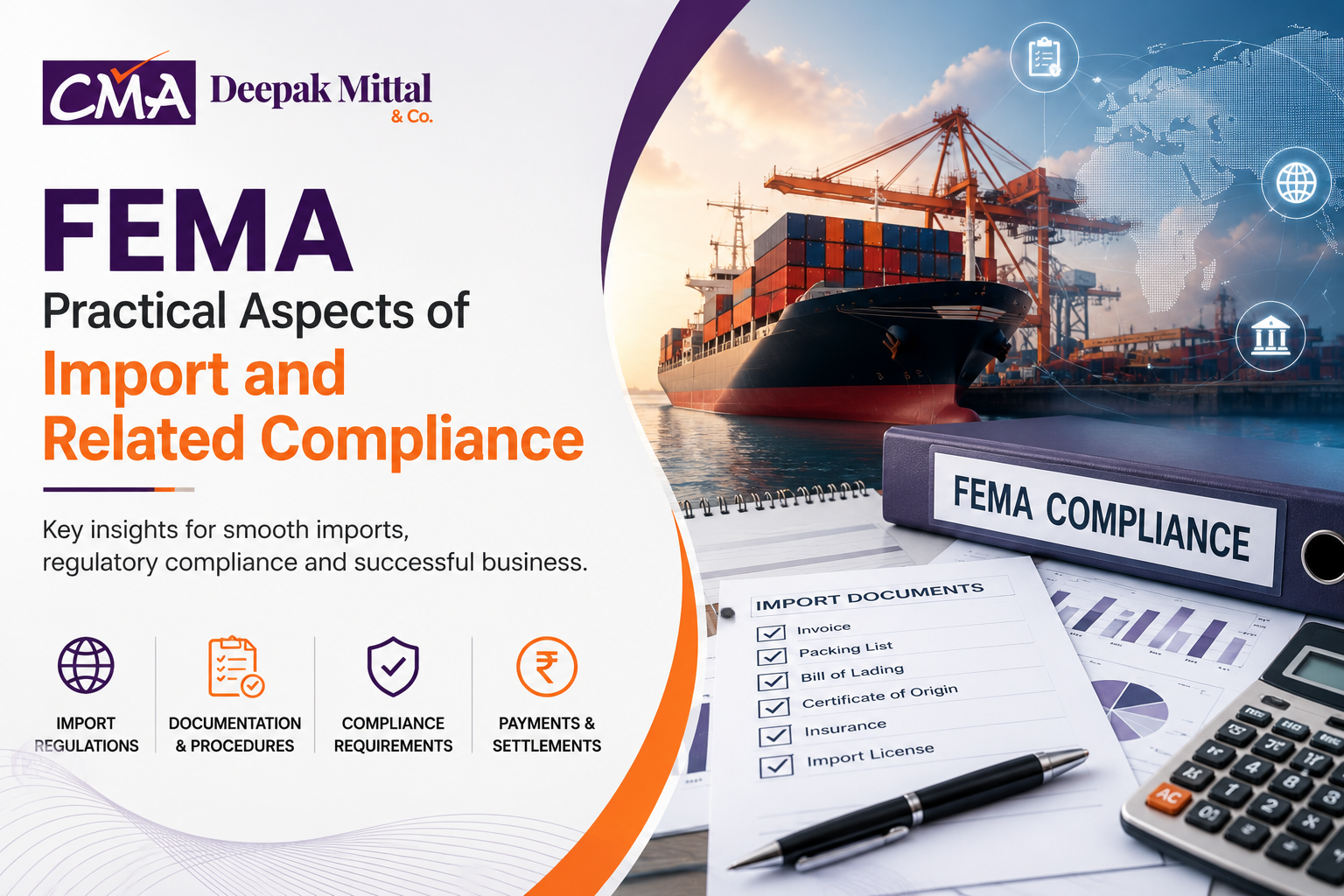
Cross-border trade compliance works smoothly only when FEMA documentation, banking requirements, and tax remittance rules are aligned. For practitioners, the most practical issues arise around import remittances, submission of Bill of Entry to the AD bank, classification of service payments, and the applicability of Forms 15CA and 15CB.
Under FEMA, remittances for genuine import of goods and services are generally treated as current account transactions and are processed through an AD Category-I bank subject to documentary verification and purpose code mapping.
In practice, the bank checks the contract, invoice, import evidence, purpose code, and the overall bona fide nature of the transaction before releasing foreign exchange.
For import of goods, the key operational document is the Bill of Entry, while for import of services the focus shifts to the agreement, invoice, service description, and taxability in India.
This distinction is important because FEMA compliance for goods is document-driven through customs evidence, whereas service remittances require stronger analysis of the nature of payment and withholding tax exposure.
In import of goods, the Bill of Entry is the principal proof that the remittance resulted in actual import, and the AD bank uses it to reconcile the outward remittance in the import monitoring system.
The importer should ensure that the correct AD code is reflected and that the Bill of Entry details are submitted to the same bank through which the payment was made.
Delayed or missing submission of Bill of Entry may leave the remittance unmatched, which can trigger follow-up by the bank and create a FEMA regularisation issue even when the commercial transaction itself is genuine.
As a practical matter, professionals should track advance remittances separately and confirm closure of the transaction in the bank’s system after customs clearance.
Forms 15CA and 15CB do not apply in the same way to every foreign remittance. Pure import payments for goods are generally kept outside the reporting requirement under Rule 37BB where the remittance falls under the specified import purpose codes, so a normal goods import payment typically does not require Form 15CA or Form 15CB.
The position changes for import of services, royalty, technical fees, consultancy charges, software payments, or other sums chargeable to tax in India. In such cases, Section 195 becomes relevant, taxability must be examined under the Income-tax Act and applicable DTAA, and Form 15CB followed by the appropriate part of Form 15CA may be required before remittance.
For practitioners, the real working test is simple:
First identify whether the payment is for goods or for a taxable service.
Next determine whether the amount is chargeable to tax in India.
Then align bank documentation, TDS compliance, and the remittance formality accordingly.
Although a Shipping Bill is not relevant for import transactions, it deserves brief mention for completeness because it is the export-side equivalent of customs evidence.
In export of goods, the Shipping Bill is filed with customs for clearance and later supports reconciliation of export proceeds by the AD bank.
Accordingly:
Bill of Entry is central to import compliance.
Shipping Bill is central to export compliance.
Keeping this distinction clear helps avoid mixing import documentation with export banking requirements in advisory and audit work.
From a working perspective, FEMA compliance in imports is not only about making the remittance but also about closing the documentary trail.
Import of goods requires strong follow-up on Bill of Entry submission.
Import of services requires careful tax characterization and review of Form 15CA and 15CB applicability.
For a CMA in practice, the safest approach is to treat every foreign remittance as a three-part review:
FEMA purpose and banking documents
Customs or service evidence
Income-tax withholding compliance
This approach reduces the risk of unmatched remittances, incorrect certification, and avoidable bank objections.
